


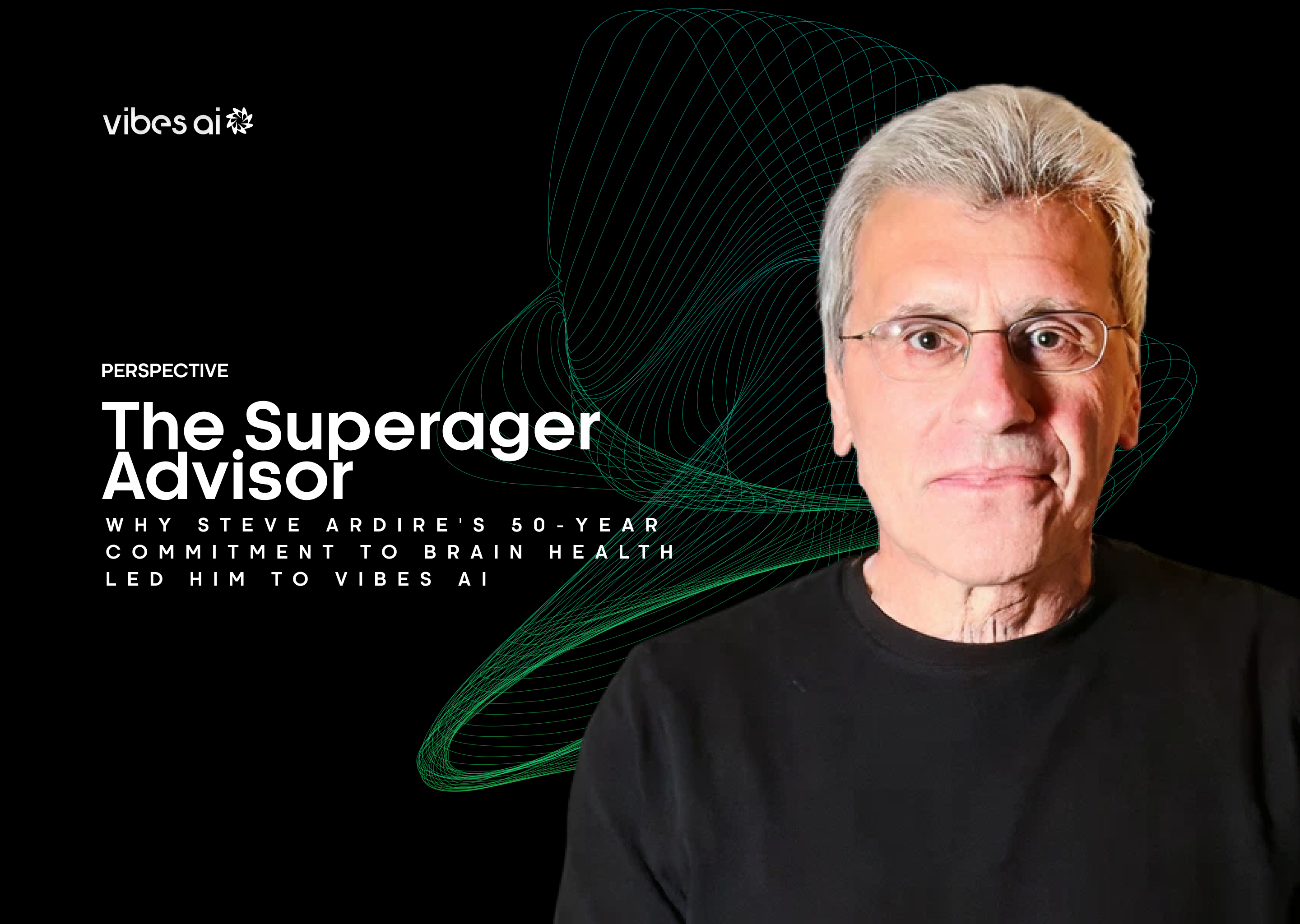
Research shows 40% of cognitive decline is preventable, and "superagers" share distinct traits: sociability, tenacity, and brain structures that resist aging. At 69, Strategic Advisor Steve Ardire lives these findings: maintaining his high school weight, testing 20 years younger biologically, and following a five-decade commitment to brain health. A family story about early detection explains why he believes voice biomarkers and restorative audio represent the future of cognitive wellness.
Today marks International Day of Older Persons—a moment to recognize the transformative role older adults play in building resilient, equitable societies. The 2025 United Nations theme, "Older Persons Driving Local and Global Action: Our Aspirations, Our Well-Being and Our Rights," challenges a pervasive cultural narrative: that cognitive decline is simply an inevitable part of aging.
The research tells a different story. According to The Lancet Commission on Dementia Prevention, Intervention, and Care, up to 40% of cognitive decline is preventable through lifestyle interventions (Livingston et al., 2024). Northwestern University's 25-year study of "superagers"—people over 80 with the cognitive function of someone decades younger—reveals consistent traits: sociability, tenacity, and brain structures that support motivation, memory, and learning (Cook et al., 2024). These aren't abstract findings reserved for research labs. They're principles being lived out daily by people like Steve Ardire, longevity enthusiast and Vibes AI’s Strategic Advisor.
A Half-Century Commitment to Vitality
At 69, turning 70 later this month, Steve Ardire maintains his high school weight of 158 pounds with a 30-inch waist. He works out every day, still has visible abdominal definition, and tests 20-25 years younger biologically. "Since high school I've had a fetish for athletics, health, holistic wellness which has carried through to the present day," he explains. But this isn't vanity. It's a deliberate commitment to maintaining cognitive vitality and what Vibes AI calls JoySpan—healthy, joyful years of life.
Steve's philosophy centers on a mantra: "Longevity starts with discipline but needs empowered individuals to achieve." Discipline, he argues, is crucial for adopting healthy habits like choosing nutritious foods, exercising regularly, getting adequate sleep, and managing stress. It's about establishing consistent patterns that support long-term wellbeing and resisting temptations that don't serve health goals.
But discipline alone isn't enough. Empowered individuals define what they want to accomplish with self-management of their health, persevere when facing challenges, and engage with others when needed. This increased confidence and sense of control fuels the motivation to maintain discipline in pursuing healthy longevity.

The Mediterranean Blueprint
Central to Steve's approach is the Mediterranean diet, which he's followed for decades. "The Mediterranean diet has stood the test of time for a reason: It works," he notes. In 2025 alone, multiple studies (Fekete et al.; Aguilera-Buenosvinos et al.; Solch-Ottaiano et al.) have linked Mediterranean-style eating patterns to better brain health, lower cancer risk, reduced blood pressure, memory protection, and beneficial effects on gut health and the microbiome.
Steve emphasizes food as medicine, pointing out that too many people take too many pills. "Healthcare systems are set up to put people on drugs, not take them off," he observes. His approach prioritizes prevention over pharmaceutical intervention, a philosophy that aligns with the CDC's finding that 80% of heart disease, stroke, and type 2 diabetes cases could be prevented through lifestyle changes (CDC, 2018).
When Prevention Fails: A Personal Turning Point
Steve's commitment to brain health isn't purely theoretical. In 1988, his then 38-year-old brother was diagnosed with a grade 2 astrocytoma brain tumor the size of a half dollar on the Rolandic fissure, affecting critical motor and sensory regions. Steve and his wife scrambled to find the best neurosurgeon, a daunting task in the pre-internet era. They found the late Dr. Robert Grossman, a legendary figure in neurosurgery who led Houston Methodist's neurosurgery department for over 30 years.
Dr. Grossman operated for seven hours with remarkable success. For the next 26 years, Steve's brother lived a healthy, normal life. Then, in 2016, an unexpected regrowth appeared—just three months after an MRI showed "normal" results. The second surgery was only 70% successful; the neurosurgeon didn't want to push into high-risk territory. Steve's brother's life was no longer normal, and he passed away in July 2022.
This experience crystallized something for Steve: early detection matters. The seven-year window that voice biomarkers can potentially provide for cognitive decline detection represents exactly the kind of early warning system that could change outcomes.
On the positive side, Steve's maternal grandfather, born in 1894, who immigrated from Italy at 17, lived to 95 with what Steve describes as mostly JoySpan, which was rare for that era. A key contributor? He exhibited traits consistent with superager research: he was highly sociable, a personality characteristic that all superagers seem to share.

Why Vibes AI?
This, Steve attended a Zoom investor preview session, Cognitive Capital, with Vibes AI founders, CEO Joanna Peña-Bickley and Chief Vibroacoustic Designer Victoria (Toy) Deiorio. "I loved the vibrant resonance," Steve recalls. He dominated the Q&A session and afterward sent suggestions on how he'd position Vibes AI. An agreement came together quickly, and Steve joined as Strategic Advisor.
What drew him to the company? Vibes AI's mission to accelerate the world's access to cognitive health and wellness resonated deeply. The company's tagline—"voice reveals, sound restores"—captures both sides of the brain health equation that Steve has lived: prevention and early detection.
"Voice reveals more than words," Steve explains. "It captures the intricate symphony of brain activity that drives every conversation, every thought, every memory. While billions are invested in brain scans and blood tests, the most powerful biomarker for cognitive health might be something you use every day. The technology to capture it is already in your pocket."
Research shows that voice biomarkers can detect elements of cognitive decline approximately seven years in advance—the kind of early warning that could have made a difference for Steve's brother. But Vibes AI doesn't stop at detection. Where competitors choose measurement OR intervention, Vibes AI does both: voice biomarkers for continuous monitoring paired with personalized Restorative Audio to measurably improve brain health.
This dual approach—proactive, continuous cognitive wellness through Daily Brain Readiness and JoySpan scores, combined with sound-based therapeutics—represents a paradigm shift from reactive care to preventive wellness.
Reframing Older Adults as Agents of Change
The UN's 2025 theme explicitly recognizes older persons as drivers of progress, not passive beneficiaries of care. Steve embodies this shift. He's not waiting for healthcare systems to catch up. He's not accepting decline as inevitable. He's actively managing his health, sharing his knowledge (see his latest LinkedIn posts), and advising companies that align with his values.
"Healthcare systems treat patients when it's too late and do not do preventative care," Steve observes. Vibes AI's approach puts the power in individuals' hands—continuous monitoring, early detection, and therapeutic intervention before symptoms manifest.
As the global population ages—with persons aged 65 or older projected to comprise around 17% of the population by 2050—the stakes for getting this right are enormous (United Nations, 2025). Steve's approach offers a roadmap: discipline, empowerment, evidence-based lifestyle choices, and technologies that support rather than replace human agency.
This International Day of Older Persons, the evidence is clear: cognitive vitality isn't about luck or genetics alone. It's about choices, consistency, and tools that support brain health throughout the lifespan. Steve Ardire proves that at 69, you can test decades younger not through pharmaceutical intervention, but through long-term commitment to the fundamentals and a willingness to embrace technologies that extend JoySpan.
We already know that up to 40% of cognitive decline is preventable. We have the research on superagers. The opportunity now is to bridge individual empowerment with healthcare innovation, moving prevention from theory to practice, and recognizing older adults not as patients waiting for decline, but as active partners in their own cognitive futures.

References
Cook, A. H., et al. (2024). Neurobiological signature of SuperAgers: A 25-year longitudinal study. Alzheimer's & Dementia.
Livingston, G., et al. (2024). Dementia prevention, intervention, and care: 2024 report of the Lancet standing Commission. The Lancet, 404(10452), 572-628.
United Nations. (2025). International Day of Older Persons. https://www.un.org/en/observances/older-persons-day
Fekete, M., Varga, P., Ungvari, Z., Fekete, J. T., Buda, A., Szappanos, Á., Lehoczki, A., Mózes, N., Grosso, G., Godos, J., Menyhart, O., Munkácsy, G., Tarantini, S., Yabluchanskiy, A., Ungvari, A., & Győrffy, B. (2025). The role of the Mediterranean diet in reducing the risk of cognitive impairement, dementia, and Alzheimer's disease: a meta-analysis. GeroScience, 47(3), 3111–3130. https://doi.org/10.1007/s11357-024-01488-3
Aguilera-Buenosvinos, I., Morales Berstein, F., González-Gil, E. M., Dossus, L., Gunter, M. J., Biessy, C., Masala, G., Santucci De Magistris, M., Laouali, N., Shah, S., Marques, C., Heath, A. K., Tsilidis, K. K., Cross, A. J., Ferrari, P., Castro-Espin, C., Debras, C., Tumino, R., Tjønneland, A., Halkjær, J., … Toledo Atucha, E. (2025). Adherence to the Mediterranean Diet and Obesity-Linked Cancer Risk in EPIC. JAMA network open, 8(2), e2461031. https://doi.org/10.1001/jamanetworkopen.2024.61031
Solch-Ottaiano, R. J., Engler-Chiurazzi, E. B., Harper, C., Wasson, S., Ogbonna, S., Ouvrier, B., Wang, H., Prats, M., McDonald, K., Biose, I. J., Rowe, L. A., Jones, M., Steele, C., Bix, G., & Maraganore, D. M. (2024). Comparison Between Two Divergent Diets, Mediterranean and Western, on Gut Microbiota and Cognitive Function in Young Sprague Dawley Rats. Gut microbes reports, 1(1), 1–21. https://doi.org/10.1080/29933935.2024.2439490
Centers for Disease Control and Prevention. (2018, September 6). Vital signs: Preventing 1 million heart attacks and strokes. U.S. Department of Health & Human Services. https://archive.cdc.gov/www_cdc_gov/media/releases/2018/t0906-vital-signs-preventing-heart-attacks-strokes.html
About Vibes AI
Vibes AI is a neurotechnology company on a mission to accelerate the world's access to cognitive health & wellness. Founded in 2024, the company uses AI, neuroscience, and ancestral intelligence to create innovative solutions that make cognitive health and enhancement accessible to all. MANTRA, one of the company's flagship products, uses voice biomarker technology to detect early signs of cognitive decline and provide personalized interventions.






No Comments.