


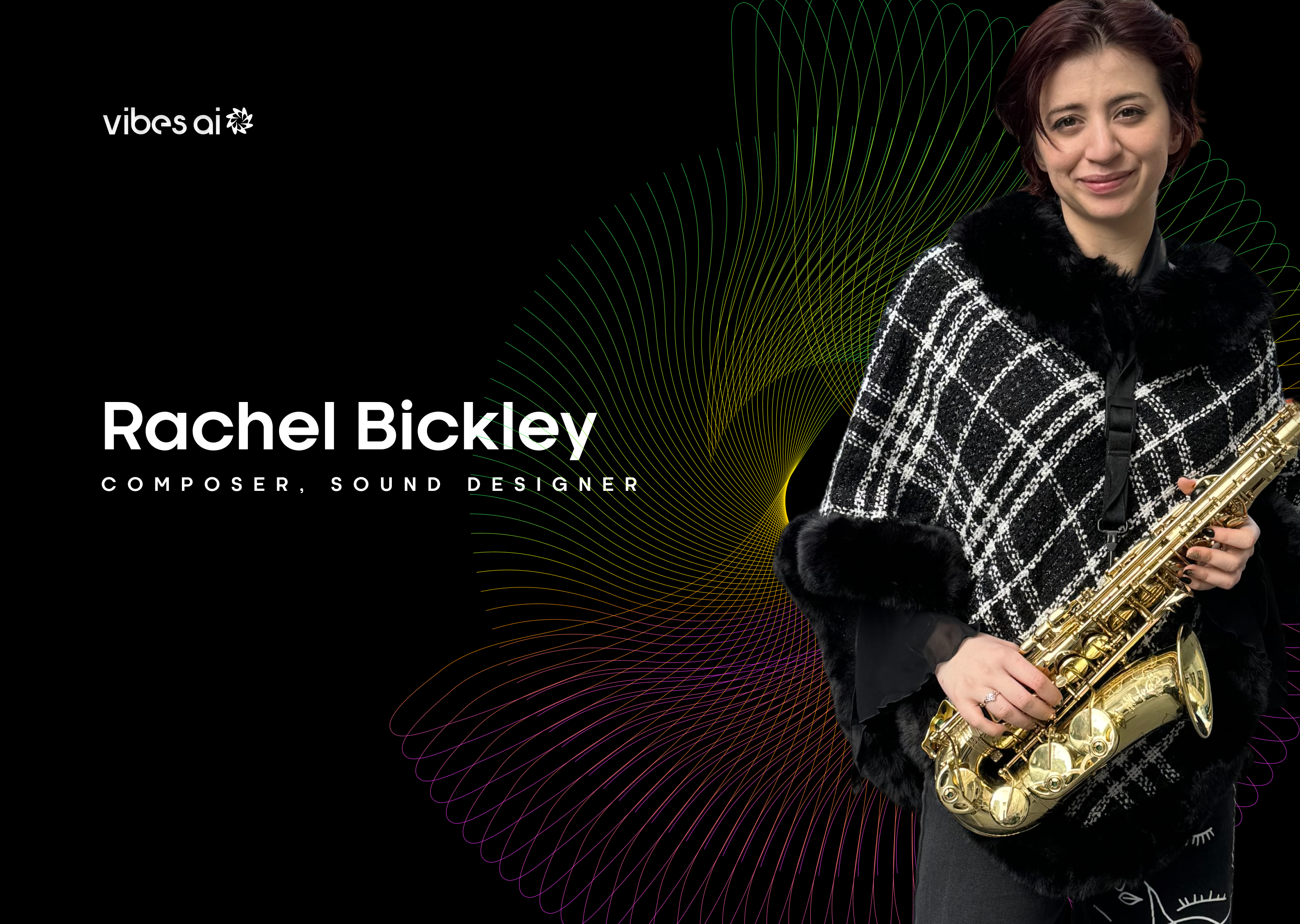
Composer, sound designer, and early Vibes AI angel investor Rachel Bickley is creating healing through heritage—one frequency at a time.
During Hispanic Heritage Month, we celebrate the rich tapestry of cultures that strengthen our communities and drive innovation. For Rachel Bickley, heritage isn't just something to honor—it's the foundation of groundbreaking work in neuroscience-backed audio therapy.
As a composer, sound designer, and one of Vibes AI's first angel investors, Rachel brings both artistic mastery and deeply personal motivation to the field of brain health. Her latest creation, "Resonancia," represents more than just another Vibe Drop in our collection. It's a bridge connecting ancestral wisdom with cutting-edge neuroscience, specifically designed to support those experiencing early cognitive impairment.
Roots That Sing
Rachel's musical lineage traces an extraordinary path through time and geography. Her Sephardic Jewish heritage connects her to ancestors who fled the Spanish Inquisition, carrying musical traditions from the Middle East through the Iberian Peninsula to Mexico. This cultural fusion lives on in her grandmother's house, where a single photograph captures six generations of women—a visual testament to the power of ancestral memory.

"My mami Yaya, my mama Rose, my grandmother, my mom, my aunt, my older sister Rebecca and myself," Rachel explains, describing the treasured family photo. "Technically that's six generations of just womanhood in one photo. Knowing that means a lot to me."
Growing up in a household where Gloria Estefan's voice announced weekend cleaning sessions and cumbia rhythms filled family gatherings, Rachel understood early that music was the soundtrack to life itself. This foundation would prove essential when she discovered her own musical gift at age four, stumbling upon a saxophone in a university music room and declaring her future right there.
From Prodigy to Professional
Rachel's musical journey reads like something from a coming-of-age film. Supported by grandfathers who recognized her talent—one gifting her a professional-grade Selmer saxophone from France—she evolved from a determined four-year-old into a teenager performing with legends like Tito Puente Jr. and jamming with Arturo Santaval at Lincoln Center.
Those formative years busking on New York streets and performing until 2 AM while maintaining high school grades shaped more than just technical skill. They instilled an understanding of music's universal language and its power to heal across cultural boundaries.


"Music is the ultimate connector," Rachel reflects. "I just got the lucky gene."
But performing took its toll. By early adulthood, Rachel stepped back from the stage, choosing instead to work behind the scenes as a direct stream digital engineer, sound designer, and now composer. This transition allowed her to maintain creative expression while establishing healthier boundaries—a decision that would prove crucial when personal tragedy deepened her commitment to brain health.
Where Heart Meets Science
Rachel's investment in Vibes AI, both financial and creative, stems from watching her beloved grandfather experience cognitive decline. "To see him in the end of his life kind of lose who he was," she shares, "it was hard because you grieved a long time ago for the loss of the man that was not there."
This grandfather, who had introduced her to jazz legends and mailed her CDs monthly to expand her musical horizons, became absent long before his body gave out. The experience crystallized Rachel's understanding that brain health affects more than individual patients, it ripples through entire families and communities.
"I don't want someone to have to see a loved one go through such a stark cognitive decline," Rachel explains. "For me, I had the funds, and I had the means to put my money where my mouth is."

Creating Healing Frequencies
Rachel's composition "Resonancia" weaves together her personal history and scientific precision. Built on the therapeutic foundation of 40Hz frequency therapy, backed by MIT research showing benefits for attention, recall, and mood regulation, the track layers Sephardic guitar influences over Mixtec drumbeat patterns.
The result is something special: a piece of music that honors ancestral wisdom while delivering measurable neurological benefits. Each element carries meaning: the steady drumbeat representing the rhythm of displaced peoples finding new homes, the guitar voicings echoing Middle Eastern melodies that traveled through Spain to the Americas.
"It's a blend of having to flee their home, but being accepted in a..." Rachel begins, then pauses, the weight of generational displacement and resilience evident in her reflection.
A second heritage track is already in development, focusing on the Mexican and Mixtec influences that shaped her Texas childhood. This upcoming composition will explore Cumbia beats and Tejano sounds, the music of Selena Quintanilla that filled her youth during Fiesta celebrations. Set for release in early October, it will offer another bridge between cultural celebration and cognitive wellness.


The Human Algorithm
In an era where AI increasingly shapes creative industries, Rachel maintains clear boundaries about technology's role in artistic expression. "I don't believe AI should be creating art," she states firmly. "But that being said, I think it can be a tool for artists."
This philosophy aligns perfectly with Vibes AI's human-first approach. While the company leverages artificial intelligence for analysis and platform functionality, the core creative work, the healing frequencies that help people focus, remember, and find calm, comes from human artists like Rachel and Co-Founder & Chief Vibroacoustic Designer, Victoria “Toy” Deiorio.
"Vibes AI's mission is human first, because it has to do with the well being and quality of life of humans," she explains. "Toy and I don't use AI to make music. We use AI to help create our blurbs into our discussion points. But the actual core of it is still human because it's going to be used on humans."
Beyond the Music
Rachel's story extends beyond professional accomplishments to personal resilience. Managing Type 2 Bipolar disorder, anxiety, depression, and learning disabilities like dyslexia, she exemplifies the reality that brain wellness isn't just about preventing cognitive decline, it's about optimizing daily life for everyone.
"The audio restorative therapies are not just for people in cognitive decline," she emphasizes. "It can be if you're feeling overwhelmed, if you're feeling unfocused... it's not just for someone suffering from dementia and Alzheimer's or a TBI, it can be for everyday or an “I'm just not feeling it today” kind of day."
"The audio restorative therapies... can be for everyday or an “I'm just not feeling it today” kind of day."
A Legacy in Sound
As Hispanic Heritage Month reminds us of the countless ways Latino communities enrich American culture, Rachel's work represents a new frontier: honoring ancestral wisdom while advancing scientific understanding of how sound heals.
Her compositions preserve cultural memory and transform it into tools for cognitive wellness. In "Resonancia," listeners don't simply hear Rachel's heritage; they experience frequencies designed to strengthen their own neural pathways. It's a profound act of cultural sharing that extends beyond appreciation to active healing.
Rachel's journey from saxophone prodigy to sound designer illustrates something fundamental about innovation: the most groundbreaking advances often come from people who honor their past while fearlessly embracing new possibilities. In her hands, heritage becomes more than history. It becomes hope, measured in hertz and delivered through headphones.
For those experiencing the early stages of cognitive change, for caregivers seeking moments of calm, for anyone wanting to strengthen their brain health, Rachel's work offers something uncommon: the healing power of ancestral wisdom, backed by modern neuroscience, and delivered with the precision that only comes from a lifetime of musical mastery.
Experience Rachel's "Resonancia" and explore Vibes AI's complete collection of Vibe Drops designed to support cognitive wellness across all communities on Apple | Spotify | Wherever You Listen.

About Vibes AI
Vibes AI is a neurotechnology company on a mission to accelerate the world's access to cognitive health & wellness. Founded in 2024, the company uses AI, neuroscience, and ancestral intelligence to create innovative solutions that make cognitive health and enhancement accessible to all. MANTRA, one of the company's flagship products, uses voice biomarker technology to detect early signs of cognitive decline and provide personalized interventions.






No Comments.